
 Study Destinations · United Kingdom
Study in the UK
World-class universities. More ways to get there.
Explore Bachelor's and Master's degrees, Foundation programmes, International Year One and Pre-Master's pathways. MultiPath Expert helps you find the right university and route for your academic background and future plans.
Free consultation · British Council-trained UK counsellors · Offices in Bucharest, Astana and Tashkent, or online
4
UK universities in the QS World Top 10 (2027)
16
UK universities in the QS World Top 100 (2027)
1 year
Typical full-time taught Master's

Pathways to leading universities
Why the UK
Why Study in the UK?
Four reasons students and families choose a British education — each one backed by official sources, not slogans.

Internationally recognised qualifications
UK degrees sit on national qualifications frameworks, are quality-assured by the QAA and regulated by the Office for Students in England — and are recognised by employers and universities worldwide.

World-class choice at every level
Four UK universities rank in the QS World Top 10 for 2027 and 16 in the Top 100, among more than 90 ranked institutions offering Bachelor's, Master's and research degrees in every field.

More ways in
Direct entry or a university pathway: Foundation, International Year One and Pre-Master's programmes at on-campus colleges let you enter at the level that matches your background.

Shorter degrees, strong outcomes
Three-year Bachelor's degrees (four in Scotland) and one-year Master's degrees mean fewer years of fees and living costs — and 87% of recent UK graduates were in work or further study 15 months on.
Sources: QAA (FHEQ 2024), Office for Students, UCAS, British Council Study UK, QS World University Rankings 2027, HESA Graduate Outcomes 2023/24. Last reviewed October 2026.
Study Routes
Bachelor's, Master's and Pathway Programmes
Whatever your starting point, there is a recognised route into a UK qualification — and International Year One can take you straight into Year 2.
Undergraduate route
International Foundation Yearif you don't yet meet Bachelor's entry requirementsYear 1Year 2Year 3Year 4 in ScotlandBachelor's degreeBA · BSc · BEng (Hons)
Fast track into Year 2
International Year Oneequivalent to Year 1, taught at a pathway collegeYear 2 of an eligible Bachelor's degreewhen the progression requirements are met
Postgraduate route
Pre-Master'sif you don't yet meet direct Master's entry requirementsMaster's degreeusually one year full-timePhD / researchtypically three to six years
Progression from a pathway programme to the degree depends on passing at the required level and meeting the programme's progression requirements, including attendance. Direct entry to Year 1 of a Bachelor's degree or to a Master's degree is available when you meet the entry requirements.
Entry route
International Foundation Year
A one-year preparation programme for school leavers who don't yet meet Bachelor's entry requirements. Pass at the required level and progress to Year 1 (Year 2 at Scottish partner universities).
Fast track
International Year One
Equivalent to the first year of a Bachelor's degree, taught at a pathway college on campus. Meet the progression requirements and move straight into Year 2 of an eligible degree — no extra year.
Undergraduate
Bachelor's degrees
Three years in England, Wales and Northern Ireland, four in Scotland; many courses add a placement year. Honours degrees (BA, BSc, BEng) are the standard route.
Postgraduate bridge
Pre-Master's
One to three terms of subject and academic-English preparation for graduates who don't yet qualify for direct Master's entry, leading to listed Master's degrees.
Postgraduate
Master's degrees
Taught MA, MSc and MBA programmes usually take one year full-time; research MRes and MPhil degrees lead towards a PhD. You apply directly to the university; January starts exist for selected courses.
English
Pre-sessional English
University courses of one to six months for offer-holders just below the required IELTS level. Complete the course and progress to your degree without re-sitting the test, under the university's rules.
Also available: MPhil and PhD research degrees of typically three to six years. Entry requirements and English-language scores are set by each university and course.
UK University Options
Explore Universities in the UK
From leading research universities to modern institutions offering career-focused degrees, we help students explore Bachelor's, Master's and university pathway opportunities across the United Kingdom.
University of Glasgow
Durham University

University of Leeds
University of Sheffield

University of Nottingham
University of Liverpool
University of York
University of Sussex

Cardiff University
Royal Holloway, University of London
Swansea University

Manchester Metropolitan University
Direct university application
Already meet the university's entry requirements?
We can help you explore suitable Bachelor's and Master's degrees, prepare your application and navigate the admissions process.
University pathway programmes
Need additional academic or English preparation?
Foundation, International Year One and Pre-Master's programmes can provide a route into a UK university when the relevant progression requirements are met.
University pathway opportunities are available through our education partners, including Kaplan International Pathways, Study Group and Navitas.
University availability and application routes vary by institution and programme. Our team will explain the relevant options and partner arrangements during your consultation.
Student Cities
Where Can You Study in the UK?
Six cities across the four UK nations, each with its own universities, pathway colleges and cost of living — and strong student cities from Newcastle and Leeds to Glasgow, Sheffield and Nottingham.
England
London
Capital of universities, culture and careers
England
Manchester
Big student city, strong industry links
England
Birmingham
The UK's second city, central and affordable
Scotland
Edinburgh
Historic capital, four-year honours degrees
Wales
Cardiff
Capital-city campus life by the coast
Northern Ireland
Belfast
Compact, friendly and cost-effective
Plan Your Start
Intakes, Scholarships and Working While Studying.
The practical side of planning a UK degree — in plain language, from official sources.
Intakes
When can you start?
Most degrees start in September or October. January starts exist for selected courses — mainly Master's and pathway programmes — and pathway colleges add November and spring starts depending on the provider and programme.
For 2027 undergraduate entry the main UCAS deadline is 13 January 2027; Master's applications go directly to the university. We plan backwards from your target start.
Scholarships
University and provider awards
Most UK universities offer international scholarships, often automatic tuition discounts for self-funded students — for example £2,500 a year at the University of Sheffield or £7,000 a year at Newcastle University for 2027 entry. Pathway providers publish their own awards.
Chevening, the UK Government's competitive scholarship programme, funds one-year Master's degrees. Values and criteria are set by each university and change yearly; nobody can guarantee a scholarship.
Working while studying
What the Student visa allows
Whether and how much you can work depends on your course level, your sponsor and the conditions on your visa. Full-time degree-level students at a university or college that is a higher education provider with a track record of compliance can usually work up to 20 hours a week in term time; students on courses below degree level — most Foundation and International Year One programmes — up to 10 hours. Full-time work is allowed in official vacations.
Some providers and all part-time courses carry no work permission. Your visa conditions always prevail.
Scholarship examples as published by each university in October 2026. Work rules: UK Immigration Rules, Appendix Student, and GOV.UK Student visa guidance, checked October 2026. Your visa conditions, not this page, are final.
How We Help
From Your First Question to Your First Day in the UK.
One consultant guides you through the whole journey to the UK — and the consultation is free.
1
Free Consultation
We start with your goals, academic background and plans for the UK.
2
University & Route Selection
Direct entry or a pathway: compare universities, colleges, cities and programmes that fit your profile and budget.
3
Application Support
Guidance through UCAS or direct applications, personal statements, documents and meeting offer conditions.
4
Scholarship Guidance
Identify university and provider scholarships you may be eligible for and how to apply for them.
5
CAS & Student Visa Guidance
Help understanding the current requirements and preparing your documents, as part of your education journey.
6
Pre-Departure & Ongoing Support
Accommodation and arrival preparation — and we stay in touch after you land.
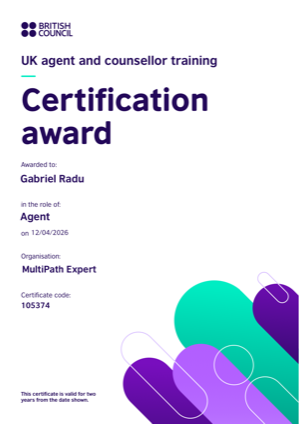
British Council training
UK Knowledge-Trained Counsellors
Our team includes counsellors who have completed British Council UK agent and counsellor training.
ICEF Accredited Agency
Agency ID 4976
International education agency recognised through the ICEF Agency Status programme.
Student Success Stories
Real Students. Real UK Universities.
Genuine stories from MultiPath students at four UK universities.
Swipe to see all four stories →

Success Story
Amirbek
BSc (Hons) International Tourism
Northumbria University

Success Story
Nazirbek
Master of International Business
Ulster University

Success Story
Khusan
PhD Engineering and Physical Sciences

University of Southampton

Success Story
Bekhruz
MSc TESOL

The University of Edinburgh
Questions, Answered
Planning Your Studies in the UK.
Practical answers to the questions students and parents ask us most. Something else on your mind? Ask us in your free consultation.
How long does a UK degree take?
Bachelor's degrees take three years in England, Wales and Northern Ireland and four in Scotland; a placement or year abroad adds a year. Taught Master's degrees usually take one year, PhDs three to six. Foundation and International Year One programmes add two to three terms before you join the degree.
What is International Year One, and who is it for?
A programme equivalent to the first year of a Bachelor's degree, taught at a pathway college on or near campus. It suits students with good secondary-school results who do not meet direct entry requirements. Meet the progression requirements and you move into Year 2 of an eligible degree at the partner university — without adding a year.
Can I work while studying in the UK?
Usually yes, within limits set by your visa. Full-time degree-level students at a higher education provider with a track record of compliance can work up to 20 hours a week in term time; students on courses below degree level, such as most Foundation and International Year One programmes, up to 10 hours. Full-time work is allowed in official vacations. Some providers and all part-time courses carry no work permission, and your visa conditions are final.
When are the intakes, and when should I apply?
Most degrees start in September or October; January starts exist for selected courses, and pathway colleges add November and spring starts. For 2027 undergraduate entry the main UCAS deadline is 13 January 2027 (15 October 2026 for Oxford, Cambridge and most medicine courses); Master's applications go directly to the university. Start 6–12 months ahead.
Do I need IELTS or another English test?
Most degrees ask for English at CEFR B2 level — often around IELTS 6.0–6.5 for Bachelor's and 6.5–7.0 for Master's — but each university and course sets its own requirement. Pathway programmes typically accept lower scores. If you are just below the level, a university pre-sessional English course can lead into your degree. We check what applies to you.
How much does it cost to study in the UK?
Tuition is set by each university; the British Council's Study UK guide quotes £11,400–£38,000 a year for undergraduate and £9,000–£30,000 for postgraduate courses. For the Student visa you must show £1,171 a month outside London or £1,529 in London for up to nine months (£1,203 and £1,570 for applications from 30 November 2026), plus the £776-a-year health surcharge and the £558 visa fee (GOV.UK, October 2026). We help you budget realistically.
Are scholarships available for international students?
Yes. Most universities offer international scholarships, often automatic tuition discounts for self-funded students of roughly £2,000–£7,000 a year at the examples we checked, and the UK Government's Chevening programme funds one-year Master's degrees for competitive candidates. Each university sets its own criteria and values change yearly, so we check the current options for your profile. Nobody can guarantee a scholarship.
Which UK universities can MultiPath help me apply to?
Through our agreements with Kaplan International Pathways, Study Group and Navitas we advise on pathway programmes leading to around 40 UK universities. For other universities we support your direct application. Our relationship with pathway universities is through the provider, and admission decisions are always made by the college or university.
Contact Us
Get Your Free Study in the UK Consultation
Have questions about studying in the UK? Our team can help you with universities, pathways, applications, scholarships and your next steps.
Tell us what you’re looking for and we’ll help you find the right route.
Free consultation · Personalised guidance · No obligation